

There are two surviving letters from April 1895 (or at least that I’ve found).
One is dated April 25 and addressed to Florence (most likely KCB’s brother Joseph Carson’s wife) and one is dated April 28 and addressed to My Darling Auntie.
KCB tells her sister-in-law “If everything goes well with me, you will have occasion to congratulate me the 1st of September.” She goes on to say she’s been “wretchedly sick and unhappy being so far from home that I haven’t had the heart to write about it.” That may explain weeks without letters.
…I thought perhaps it would make those I love uneasy about me. But I don’t feel quite as low in my spirits as I did, only it is an awfully lonely feeling not to have a friend on this side the broad ocean.
KCB, St. Petersburg to Florence, April 25, 1895
Breckinridge Family Papers, Library of Congress.
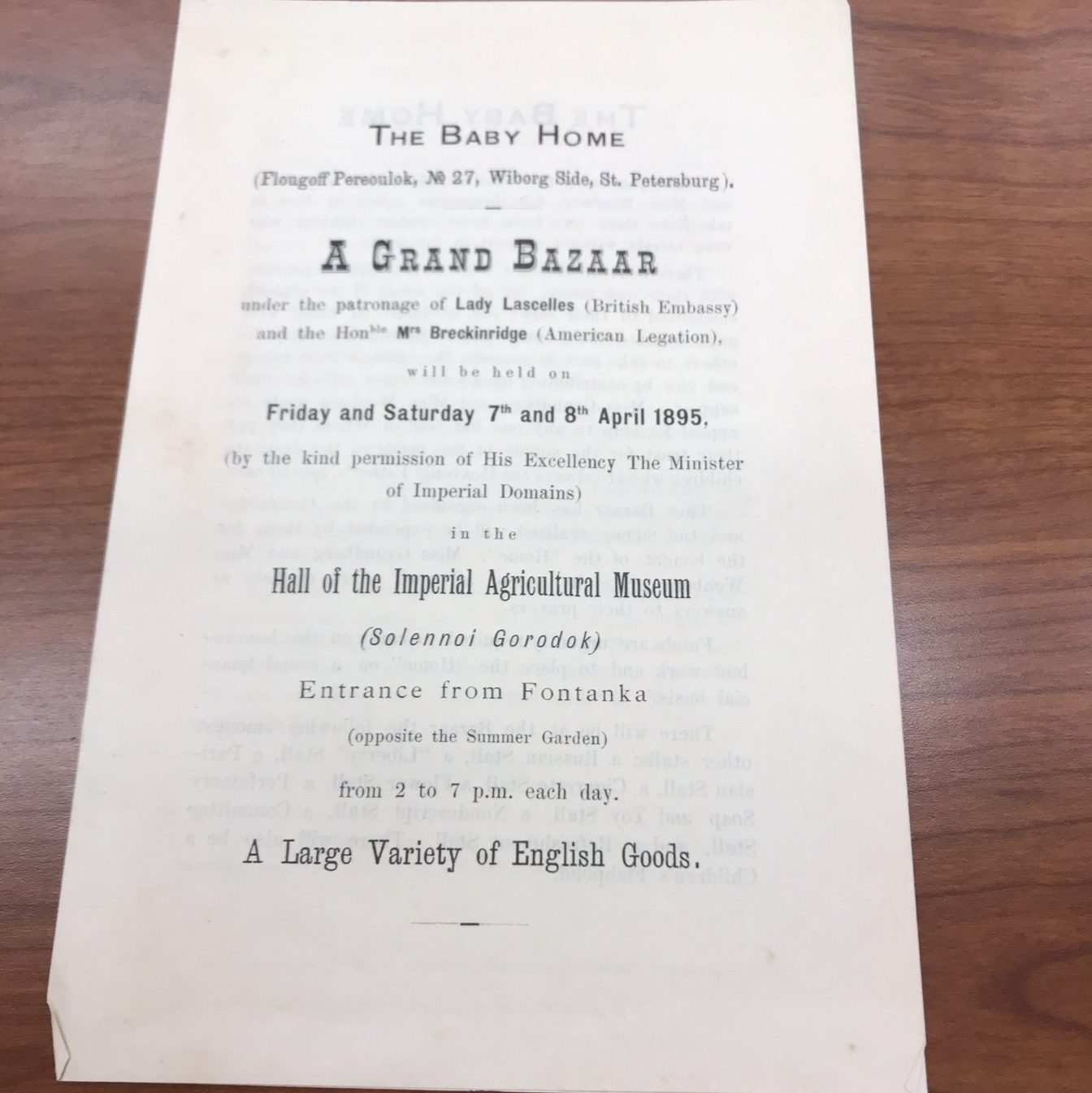
KCB mentioned the Bazaar and that Mary Breckinridge “presented a bouquet of flowers to the Grand Duchess” at the Bazaar. She doesn’t mention which Grand Duchess. She also tells her auntie in the letter dated April 28, 1895, that the Emperor sent 250 potted plants “to sell cut flowers and large planters for decoration. And 500 roubles. The Empress sent us 500 roubles. We cleared 6000.”
KCB had requested money from her auntie because of expenses (for dinners she was expected to give). She tells her aunt (April 28) that it wasn’t “absolutely obligatory” to give the dinners she thought she would be required to give but “it is a great comfort to have [the money] in the bank in case of need.”
… as I was not well and had nothing I could wear, we decided to put [the dinners] off till fall or next winter.
KCB, Petersburg to My darling auntie, April 28, 1895
She informs her aunt (April 28) that they “expect to go to Finland” in the middle of May (1895) but directs her aunt to continue to send mail to St Petersburg. Apparently, the mail in the country/Finland is “said to be irregular.” KCB tells her aunt that there will be “daily communications” with the Legation and instructs her aunt to make sure to write “Legation des Stats Unis, instead of the English.”
… the letters will be delivered much more promptly when letters are directed [because when addresses are written] in English they have to be held for a translation.
KCB, Petersburg to My darling auntie, April 28, 1895
The majority of both letters cover pregnancy and childbirth in Russia compared to America.
I am so glad you are getting on so well, I was worried at the idea of you being confined on the plantation, it seems so far from the doctor.”
KCB, St. Petersburg to Florence, April 25, 1895
…everything here is so differnt from what I have been used to…”
KCB, St. Petersburg to Florence, April 25, 1895
Finding a doctor/midwife/nurse presents a challenge for KCB. She tells her aunt that she’s “come to the conclusion that I won’t find [a nurse] such as we have.” She explains that all are trained as midwives and they don’t want to be nurses as well. She explains “Russians love to surround themselves with a multiplicity of servants” and are very set in their way and won’t do things differently. The Russian way (according to KCB) is that a professional nurse stays with the new mother for three days and then comes twice a day to check-in. This costs 100 roubles per week. Between the nurse’s visits “the [new mother] is supposed to have a skillful maid to attend her.”
In Russia “wet nursing is quite an industry.”
… no Russian mother nurses her children.
KCB, Petersburg to My darling auntie, April 28, 1895
KCB describes wet nurses as “large coarse looking creatures and are said to be utterly untrustworthy. They are from the lowest walks of life. In consequence, it naturally follows, they must have a keeper.” The keeper makes sure the wet nurse gets enough exercise and doesn’t go to unsuitable places. Wet nurses have specific uniforms and they are seen all over Saint Petersburg. The uniform is made up of a “full round skirt and long sacque (?) elaborately trimmed with gold braid and fringe.” The nurses wear head-covering “something resembling a crown, covered with red and thickly covered with gold, silver or white beads.” The uniforms are colored according to the gender of the child she’s nursing. If the child is a boy, the wet nurse wears a “brilliant red” dress. If the child is a girl the wet nurse wears a “bright blue” dress. KCB has also seen wet nurses in lavender and assumes that is for twins.
They say in this climate which is so fatal to young children, a baby cannot [be] brought up by bottle at all.
KCB, Petersburg to My darling auntie, April 28, 1895
KCB wants to nurse her own child. She wants to keep the child in her room and have a nurse look after her and the baby. “I told [the monthly nurse who the doctor recommends] what I wanted that I would keep the child in my own room, nurse it myself and would expect her to take entire charge of it and me for one month. And stay in the room at night as well.” The nurse agreed but wants to bring an assistant with her. KCB doesn’t want the assistant and says she will have just the nurse or not at all. The nurse agreed for 500 roubles. But then KCB decides not to have the monthly nurse because she might have employ the nurse for a month before the child came (which would be another 500 roubles).
KCB told her aunt that she “refuse[s] to turn the baby over to their way of doing.” However in the next sentence, she says “I may have to come to the Russian way of doing as far as I am concerned” because she has to have someone help her with the baby. She wonders if she might just get a nurse twice a day for two weeks and “try and get a good ordinary nurse to stay in the room with me and the baby, and I can have oversight over the baby.” An English midwife was recommended by her pastor but she had a diploma as a midwife but had no experience. KCB considers using her.
KCB tells her aunt that they have fired the governess because the governess was “high tempered” and the girls “didn’t like her.” But she will have to get a new governess because “the children cannot go out of the house without one” and KCB is not strong enough to go with them.
And a KCB letter home wouldn’t be complete without a little talk about the weather. Her brother wants to know about the lack of sunshine during the winter.
It is owning principally to our being so far north. Our apartment faces south, where the sun makes his appearance in the winter about eleven o’clock. It rises just above the house tops across the housetops, moves along perhaps for a quarter of a square and sinks about three, in almost the same place it came from. But we seldom had the benefit of it even for this short time, owning to heavy fogs & thick clouds.
KCB, St. Petersburg to Florence, April 25, 1895
She tells her sister-in-law that March and April were “bright and pleasant” and that the sunlight is increasing at a rate of 1/2 hour per week. Despite the warm weather “we don’t dare make changes in our clothes yet, except that we left off our furs.” She explains that by midsummer the sun sets at 11pm and rises at 2am. She also explains that they often don’t see the sun because of fog and clouds.
 MuseumGirlKnitZ